
Table of Contents
- What Your Property Inspector Isn’t Telling You About Underground Pipes
- The Hidden Cost of Owning a Building Built Before 1980
- What Lies Beneath: The Five Critical Defects Hiding in Your Sewer Lines
- The Numbers Don’t Lie: How Video Inspections Protect Your NOI and Deal Structure
- Environmental Liability: Why One Illegal Cross-Connection Can Cost You $64,618 Per Day
- Precision Diagnostics: How Modern Video Inspection Technology Works
- Key Takeaways
Commercial real estate investors know that due diligence is non-negotiable. You scrutinize rent rolls, environmental reports, roof conditions, and HVAC systems—but there’s a critical component hiding beneath your feet that could cost you tens of thousands of dollars: underground utility infrastructure.
In the Pacific Northwest, where geological challenges meet stringent environmental regulations, the “out of sight, out of mind” approach to subsurface sewer and storm systems is financially dangerous. According to the American Society of Civil Engineers, U.S. wastewater infrastructure earned a grade of D- in its most recent Infrastructure Report Card. Much of the commercial building stock in Washington and Oregon was constructed between 1950 and 1980, meaning underground pipes have likely exceeded their design lifespan.
The stakes are high: A collapsed sewer line discovered post-closing can trigger emergency repairs costing $40,000–$100,000, business interruption for industrial tenants, and potential EPA fines up to $64,618 per day for illicit discharges. Yet standard property condition assessments under ASTM E2018-15 explicitly exclude subsurface utility inspections.
This article reveals why video pipe inspections are essential risk management tools for commercial investors—and how a $1,500 inspection can prevent six-figure disasters.
What Your Property Inspector Isn’t Telling You About Underground Pipes
Standard commercial property inspections follow rigorous protocols—but they have a critical limitation when it comes to subsurface infrastructure. The industry-standard ASTM E2018-15: Standard Guide for Property Condition Assessments only requires field observers to inspect components that are “easily visible and readily accessible.”
The Reality: An inspector will flush a toilet or run water down a drain. If it drains without immediate backup, the system “passes.” This superficial test cannot detect root intrusion, pipe collapse, bellies, or offset joints that may fail weeks after closing.
“Caveat Emptor” in Commercial Transactions
Unlike residential real estate with strong consumer protection laws, commercial transactions rely on “Caveat Emptor” (Let the Buyer Beware).
Courts hold commercial buyers to a higher standard of sophistication. If you fail to inspect the sewer line and discover a $100,000 collapse post-closing, you have limited legal recourse unless you can prove active concealment by the seller.
The False Sense of Security
Many investors assume that if the property has been operational for years, the infrastructure must be fine.
The Truth: Aging pipes can function marginally for years before catastrophic failure. A small crack becomes a root ball invasion; a minor belly becomes a sediment blockage requiring emergency hydro-jetting. By the time visible symptoms appear, the damage is already extensive—and expensive.
The Hidden Cost of Owning a Building Built Before 1980
The Pacific Northwest’s commercial inventory largely dates to the mid-20th century. Understanding the lifespan of common pipe materials reveals why statistical failure is not a matter of “if,” but “when.”
Infrastructure Crisis by the Numbers
The American Society of Civil Engineers gave U.S. wastewater infrastructure a grade of D-. Much of the commercial building stock in Washington and Oregon was constructed between 1950 and 1980, meaning underground piping is 40–70+ years old.
Common Pipe Materials and Their Failure Modes
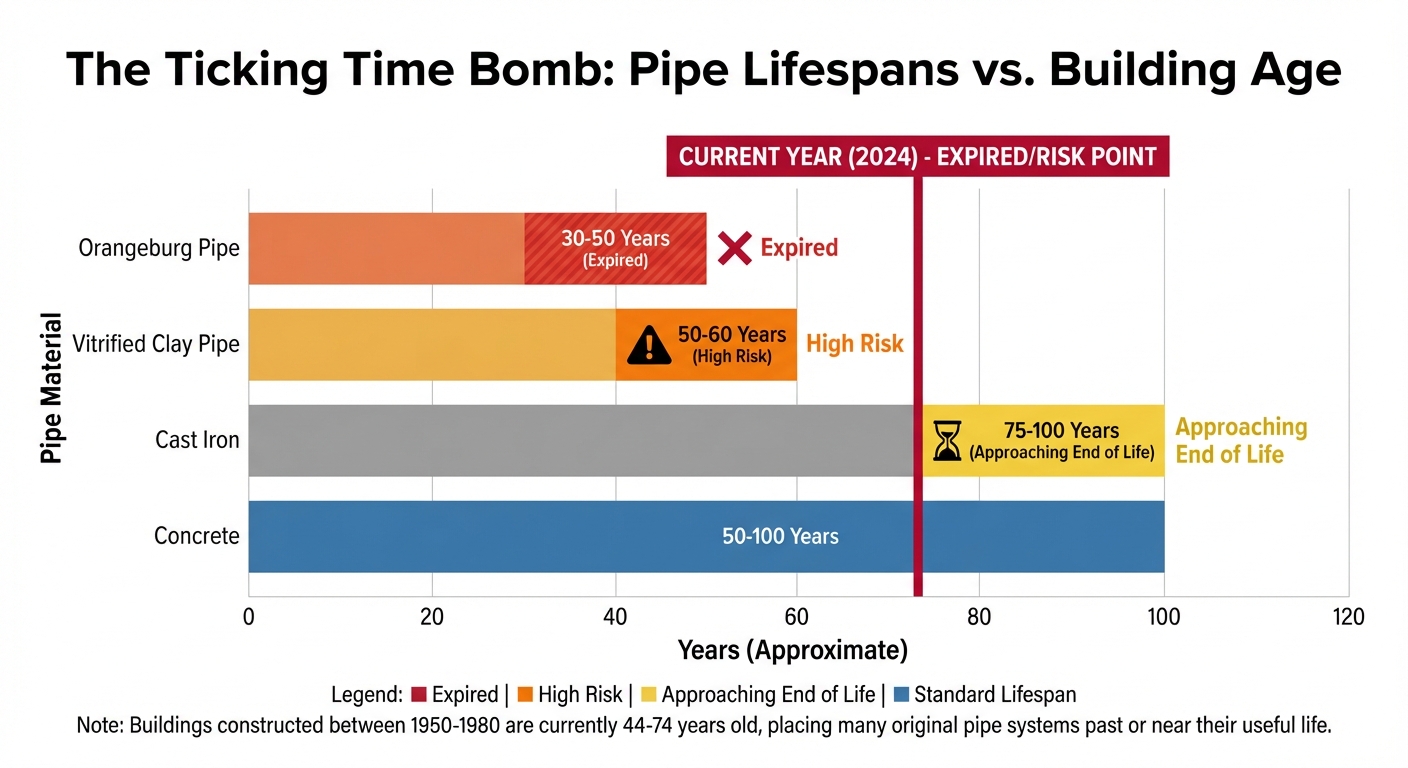
Orangeburg (Bituminous Fiber Pipe): Common in the 1940s–1970s with a design life of 30–50 years. This compressed wood fiber pipe impregnated with coal tar was inexpensive but notoriously unstable. Failure mode includes deforming into an oval shape (called “ovaling”), blistering, and complete collapse.
Vitrified Clay Pipe (VCP): The pre-1980s standard with a design life of 50–60 years. While durable against chemical corrosion, VCP’s bell-and-spigot joints are vulnerable to root intrusion. Ground shifting from seismic activity or soil settlement can crack the brittle material.
Cast Iron: Found in pre-1980s construction with a design life of 75–100 years. Cast iron suffers from bottom channeling—corrosion from standing water that eats through the pipe from the inside out. Tuberculation (rust buildup) reduces flow capacity and creates rough surfaces where debris accumulates.
Concrete: Common in industrial and storm systems with a design life of 50–100 years. Hydrogen sulfide gas produced by bacterial breakdown of sewage creates sulfuric acid that corrodes concrete from within. Over time, the aggregate becomes exposed and the structural integrity compromises.
Regional Geological Challenges
The Pacific Northwest sits along the Cascadia Subduction Zone. Even minor seismic activity or seasonal ground swelling from heavy rainfall can shift soil and shear pipe joints.
Clay-Heavy Soils: Washington and Oregon’s expansive clay soils swell when wet and shrink when dry, exerting continuous pressure on buried pipes. This cyclical stress accelerates joint separation and cracking.
Statistical Probability of Defects
If a building’s sewer system is 50+ years old and constructed with Orangeburg or clay pipe, the statistical likelihood of a structural defect is extremely high.
Key Insight: A video inspection doesn’t just identify current problems—it reveals the remaining useful life of the system, allowing investors to forecast capital expenditures accurately. This transforms underground infrastructure from an unknown variable into a quantifiable line item in your investment model.
What Lies Beneath: The Five Critical Defects Hiding in Your Sewer Lines

A. Bellies (Sags) and Sediment Accumulation
A “belly” is a section of pipe that has lost grade (proper slope) and sinks, creating a low spot that holds standing water and waste.
Why It Happens: Poor soil compaction during construction, geological settling over decades, or seismic ground movement causes sections of pipe to drop below the intended grade line.
The Consequence: In commercial settings like restaurants, food processing facilities, and industrial manufacturing plants, grease and heavy solids settle in the belly. This creates a choke point requiring frequent, expensive hydro-jetting maintenance. Standing water accelerates corrosion of cast iron and erosion of concrete.
Real-World Impact: A manufacturing facility may experience chronic “slow drains” for months before a complete blockage shuts down operations. The accumulated debris hardens over time, eventually requiring excavation rather than simple cleaning.
B. Offset Joints and Seismic Vulnerability
Two pipe sections lose alignment, creating a gap or step in the line where segments no longer fit together properly.
Regional Risk: The Pacific Northwest’s seismic activity (even minor tremors) or seasonal ground swelling can shear pipe joints. Frost heaving in colder months further stresses underground connections.
Two-Way Problem:
Infiltration: Groundwater enters the sewer line through the gap, forcing the property owner to pay to treat clean rainwater at municipal rates. In severe cases, infiltration can overwhelm the system during heavy rainfall, causing backups.
Exfiltration: Sewage leaks into surrounding soil, potentially creating sinkholes under parking lots or building foundations as the soil bedding is washed away. This underground erosion often goes unnoticed until surface pavement begins to crack or settle.
C. Root Intrusion
Tree and shrub roots grow into sewer lines through cracks or joints, seeking the nutrient-rich water inside.
The Problem: Roots form dense mats that block flow and accelerate pipe degradation. As roots expand, they widen cracks and separate joints, creating larger entry points for additional growth.
Cost Impact: Hydro-jetting can temporarily clear roots, but they return within 6-12 months. The only permanent solution is excavation and replacement or Cured-in-Place Pipe (CIPP) lining. Property owners often face an endless cycle of expensive maintenance without addressing the underlying structural defect.
D. Cross-Bores (Life Safety Hazard)
A cross-bore occurs when a utility line (typically gas) is unknowingly drilled through a sewer line during underground boring projects.
The Danger: If a hydro-jet or auger is used to clear a blockage in a sewer line containing a gas cross-bore, it can rupture the gas line and cause an explosion. Multiple fatalities have been documented nationally from this scenario.
Detection: Only video inspection can identify cross-bores before maintenance work begins. Standard drain cleaning companies often don’t know they’ve hit a gas line until it’s too late.
E. Corrosion and Channeling in Cast Iron
Cast iron pipes corrode from the bottom up (called “bottom channeling”) due to standing water and hydrogen sulfide gas produced by bacterial breakdown of sewage.
The Result: The pipe appears intact from the outside but has lost structural integrity. The top half may be sound while the bottom has corroded completely through. A sudden collapse can occur without warning, often triggered by heavy equipment passing overhead or increased hydraulic load.
The Numbers Don’t Lie: How Video Inspections Protect Your NOI and Deal Structure
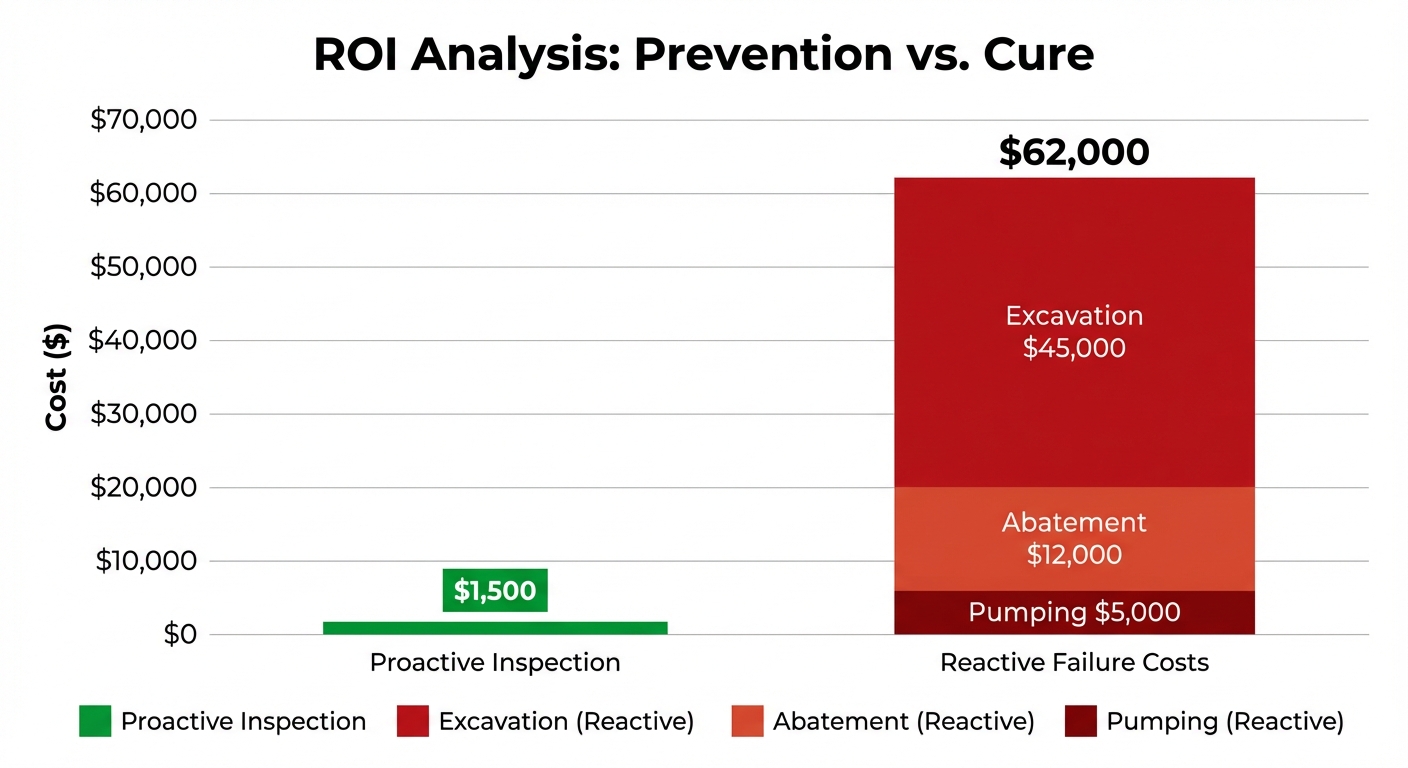
Cost of Inspection vs. Cost of Repair
Video Pipe Inspection: $800–$2,500 (depending on system complexity and linear feet).
Emergency Sewer Repair (excavation under paved lot): $40,000–$100,000+.
ROI: A single inspection that identifies a defect and allows for price renegotiation pays for itself 20x–50x over. Even if the inspection reveals no issues, you’ve purchased certainty—a valuable commodity in commercial real estate.
Capital Expenditure (CapEx) vs. Operating Expense (OpEx)
Forecasting Advantage: A video inspection allows investors to categorize sewer status with precision. A line with 5 years of remaining life can be budgeted into the CapEx plan with accurate timeline projections. A collapsed line requires immediate capital allocation—information that fundamentally changes your investment model.
Pro Forma Accuracy: Without inspection, your financial model is based on assumptions and best-case scenarios. With inspection, you have data-driven CapEx forecasting that lenders and investors can trust. This transparency improves your ability to secure favorable financing terms.
Negotiation Leverage (“Re-Trading the Deal”)
If a defect is discovered during due diligence, the buyer can reopen price negotiations with concrete evidence rather than speculation.
Example Scenario: Inspection reveals a $40,000 repair is needed. The buyer demands a credit at closing, effectively lowering the acquisition cost by $40,000. Immediate ROI: 16x–50x the cost of the inspection. Even partial seller concessions deliver substantial returns.
Alternatively, the buyer can require the seller to complete repairs before closing, transferring the risk and logistical burden entirely. This approach protects your capital for planned improvements rather than emergency repairs.
The Hidden Cost: Business Interruption for Industrial Tenants
For industrial tenants, downtime equals lost revenue—a cost that cascades far beyond the direct repair expenses.
Scenario: A manufacturing plant relies on process water drainage for production operations. If the main sewer line collapses, production stops immediately.
Cost Cascade: Excavating a sewer line through a factory floor or primary shipping lane results in:
- Breaking concrete and asphalt (often requiring specialized equipment)
- Diverting traffic and halting business operations for days or weeks
- Tenant rent abatement during repairs (contractually required in most industrial leases)
- Potential loss of the tenant to a competitor’s facility if disruption is severe
- Damage to your reputation as a landlord, affecting future leasing prospects
Total Disruption Cost: Often exceeds the direct cost of the pipe repair itself. A $45,000 excavation and repair can easily balloon to $100,000+ in total economic impact when business interruption is factored in.
Case Study: The $62,000 Latent Defect
An investment group purchased a light industrial park in Portland, OR. The general inspection noted “slow drains” but attributed it to tenant use patterns. No video scope was performed.
The Event: Six months post-closing, the parking lot flooded with sewage during heavy rainfall—a health hazard that required immediate emergency response.
The Diagnosis: Video inspection revealed a collapsed 8-inch concrete line and complete root occlusion. Years of undiagnosed corrosion had weakened the pipe until seasonal ground swelling caused catastrophic failure.
Financial Impact:
- Emergency pumping: $5,000
- Excavation & repair: $45,000
- Tenant rent abatement: $12,000
- Total Unbudgeted Cost: $62,000
The Lesson: A $1,500 pre-purchase inspection would have identified the imminent collapse, allowing buyers to demand a $62,000 credit or pre-closing repair. Instead, the investment group absorbed the full cost and experienced tenant relations damage that affected lease renewals.
Environmental Liability: Why One Illegal Cross-Connection Can Cost You $64,618 Per Day
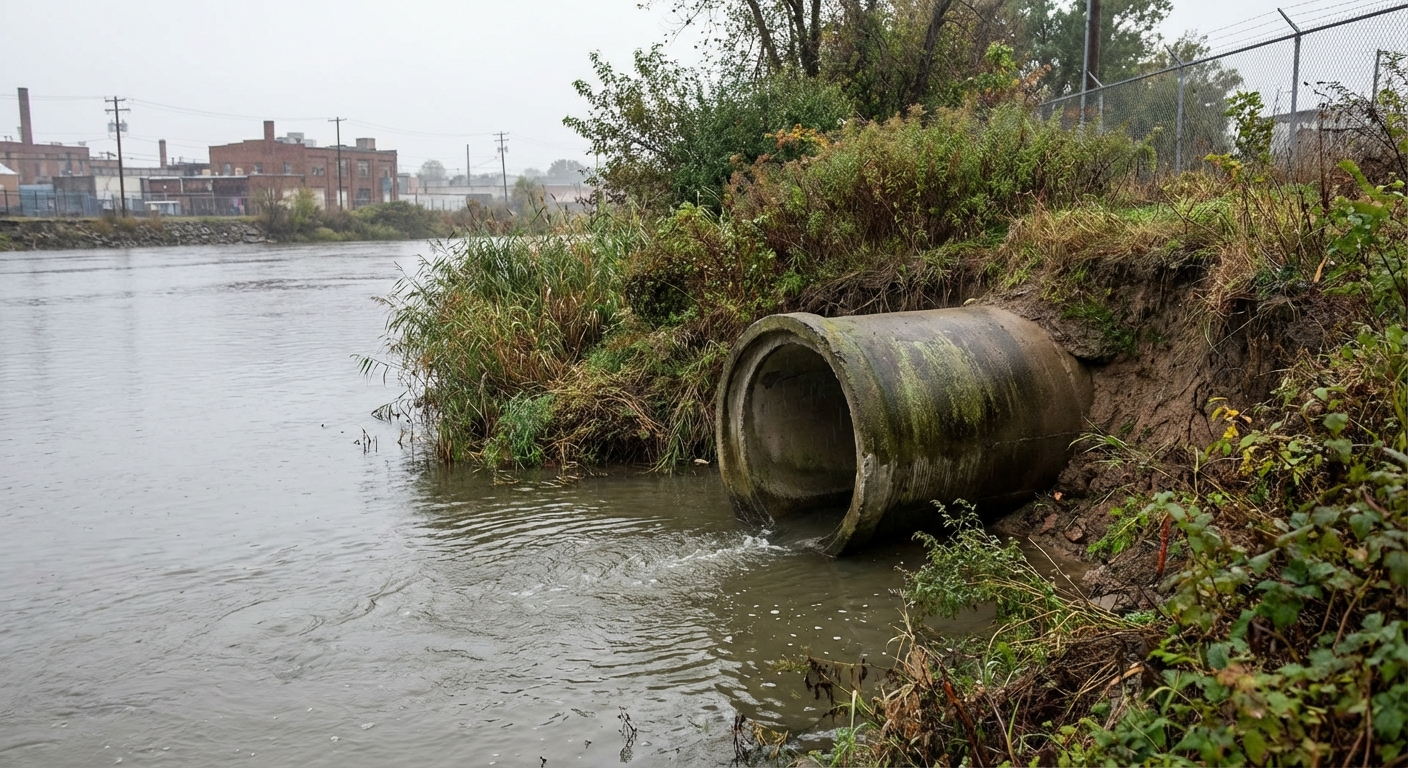
The Pacific Northwest has some of the strictest environmental regulations in the country. Uninspected underground systems can expose investors to catastrophic EPA fines and municipal violations that dwarf the cost of the original property purchase.
Illicit Discharge and the Clean Water Act
Commercial properties frequently have “cross-connections” where sanitary sewer lines are incorrectly connected to storm drains (or vice versa). These connections may have existed for decades without detection.
The Violation: If industrial waste or sewage enters the stormwater system (which drains directly to rivers like the Columbia or Willamette), the property owner is in violation of the Clean Water Act. Stormwater systems are designed to handle only clean runoff—any contamination is considered an illicit discharge.
Fines: The EPA can levy civil penalties of up to $64,618 per day, per violation (adjusted for inflation, 2024) for unauthorized discharges. These fines continue to accrue daily until the violation is corrected.
Liability Transfer: Buying a property with an existing illegal connection transfers this liability to the new owner immediately. The seller walks away clean while the buyer inherits the violation and associated penalties. EPA enforcement actions follow the property, not the individual who created the problem.
Washington Department of Ecology & Oregon DEQ
Both the Washington Department of Ecology and the Oregon Department of Environmental Quality (DEQ) mandate strict stormwater management. State-level enforcement often precedes federal action, and penalties can be equally severe.
Many municipalities now require a sewer scope certification before a property title can be transferred—a trend expanding from residential to commercial sectors. Forward-thinking investors should anticipate this becoming standard practice region-wide within 5-10 years.
Infiltration/Inflow (I/I) Charges
When groundwater infiltrates a damaged sewer line, it increases the volume of water entering the municipal treatment system. This dilutes the waste stream and wastes treatment capacity on clean water.
Cost to Owner: Municipalities charge for treating this extra water. In some jurisdictions, property owners with documented I/I issues face surcharges on their sewer bills until the defect is repaired. These surcharges can amount to thousands of dollars annually—an operating expense that directly impacts NOI and property valuation.
Flow Monitoring: Advanced municipalities now use flow monitoring to identify properties contributing excess clear water to the sewer system. Once identified, property owners receive compliance orders requiring inspection and repair within specified timeframes.
Discovery Through Video Inspection
Video inspection can identify:
- Cross-connections between sanitary and storm systems that create illegal discharge pathways
- Exfiltration points where sewage is leaking into soil (environmental contamination that can migrate to groundwater)
- Infiltration points where groundwater is entering the sewer (the source of I/I surcharges)
Proactive Compliance: Identifying and remediating these issues before closing eliminates regulatory risk and protects the buyer from inherited violations. This due diligence provides legal protection and demonstrates environmental stewardship to tenants, lenders, and partners.
Precision Diagnostics: How Modern Video Inspection Technology Works
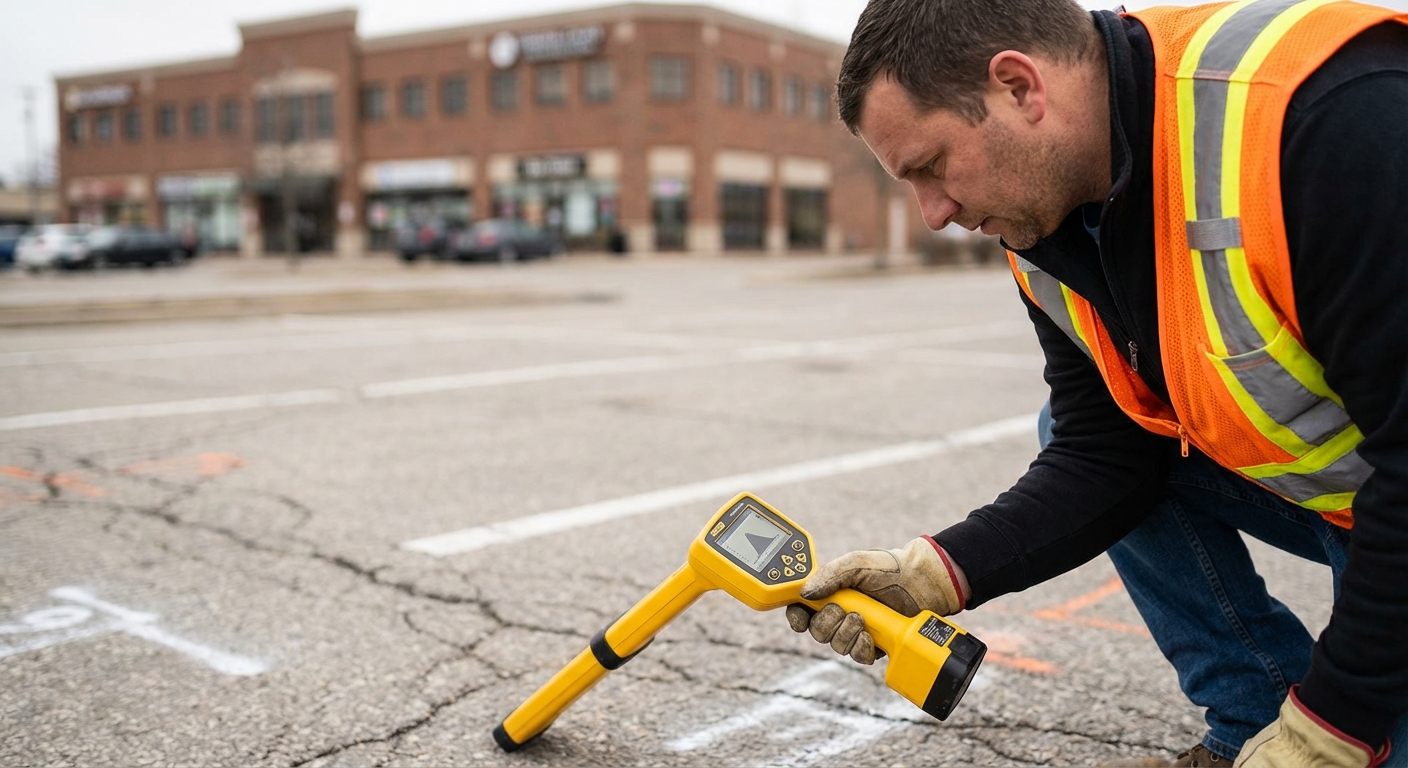
Video pipe inspection has evolved far beyond “just looking at pipes.” Modern technology enables precise defect location and supports advanced trenchless repair methodologies.
How Video Inspection Works
Robotic Crawlers or Push Cameras: Equipped with high-definition cameras and LED lighting, these devices navigate through sewer lines, capturing real-time footage. Advanced systems include pan-and-tilt cameras that provide 360-degree views of pipe interiors, ensuring no defect goes unnoticed.
Sonde Technology: Modern inspection cameras are equipped with a Sonde—a radio transmitter inside the camera head that broadcasts a locatable signal.
Application: Once a defect is spotted on the monitor, the technician uses a receiver above ground to pinpoint the exact location and depth of the issue. GPS coordinates can be recorded for future reference and construction planning.
Benefit: Eliminates “exploratory digging” that damages property and wastes money. Allows for precise surgical repairs or accurate measurements for trenchless lining. This precision reduces total project cost by 40-60% compared to traditional excavation methods.
From Problem to Solution: Cured-in-Place Pipe (CIPP)
If the inspection reveals damage, the deal doesn’t need to collapse. Cured-in-Place Pipe (CIPP) offers a trenchless solution that preserves the asset and minimizes tenant disruption.
How It Works: A resin-saturated liner is inverted into the host pipe using water or air pressure. Once positioned, it’s cured with heat or UV light, creating a new structural pipe inside the old one. The result is a seamless, jointless pipe with a 50+ year lifespan.
| Feature | Traditional Excavation | Cured-in-Place Pipe (CIPP) |
|---|---|---|
| Methodology | Digging trenches to remove/replace pipe. | Inversion of resin-saturated liner into host pipe. |
| Surface Disruption | High: Destruction of hardscapes, landscaping, floors. | Low: Access via existing manholes/cleanouts. |
| Timeframe | Weeks (permitting + excavation + restoration). | Days (often 24-48 hours). |
| Structural Integrity | Dependent on bedding/soil compaction. | Independent structural pipe (ASTM F1216). |
| Lifespan | New PVC: 50-100 years. | CIPP Liner: 50+ years. |
Investor Advantage: For commercial investors, CIPP is often the preferred remedy during a transaction because it can be executed quickly without displacing tenants or destroying parking lots. The work typically occurs outside normal business hours, and facilities remain fully operational throughout the process.
CIPP also preserves landscaping, paved surfaces, and building interiors—avoiding the aesthetic damage and restoration costs associated with excavation. For properties with established tenant bases, this minimally invasive approach protects tenant satisfaction and retention.
Key Takeaways
For commercial real estate investors, the underground infrastructure represents a significant variable that directly impacts Net Operating Income, asset liquidity, and long-term portfolio performance. Relying on visual walkthroughs, seller disclosures, or standard property condition assessments is insufficient in an era of aging infrastructure and strict environmental liability.
A professional video pipe inspection is not an expense—it’s a critical risk management tool. For $1,500–$2,500, you gain:
- Data on the “health” of the building’s arteries and remaining useful life projections
- Detection of illegal cross-connections that attract EPA fines up to $64,618 per day
- Identification of structural failures before they become catastrophic capital expenditures
- Negotiation leverage to re-trade the deal or demand seller remediation
The financial math is undeniable: a single inspection can prevent $40,000–$100,000+ in emergency repairs, business interruption costs, and regulatory penalties. In the high-stakes world of commercial real estate, where “Caveat Emptor” rules supreme, the question isn’t whether you can afford to conduct a video pipe inspection—it’s whether you can afford not to.
Don’t let due diligence stop at ground level. Go underground.
Protect Your Commercial Investment
For investors operating in the Pacific Northwest, Sarkinen Industrial Pipelining specializes in comprehensive video pipe inspections and trenchless rehabilitation solutions tailored to the unique challenges of the region. Protect your investment with data-driven infrastructure assessment before you close.
References:
- American Society of Civil Engineers (ASCE) – 2021 Report Card for America’s Infrastructure
- U.S. Environmental Protection Agency (EPA) – Civil Monetary Penalty Inflation Adjustment
- ASTM International – Standard Guide for Property Condition Assessments: Baseline Property Condition Assessment Process (E2018-15)
- American Bar Association – Caveat Emptor in Commercial Real Estate Transactions
- U.S. Department of Housing and Urban Development (HUD) – Durability of Utility Piping Systems
- Pacific Northwest Seismic Network (PNSN) – Cascadia Subduction Zone
- NASSCO – Pipeline Assessment Certification Program (PACP) Reference Manual
- U.S. Geological Survey (USGS) – Earthquake Hazards Program: Pacific Northwest
- U.S. Geological Survey (USGS) – Sinkholes: The Science Behind the Hazard
- North American Society for Trenchless Technology (NASTT) – Cured-in-Place Pipe (CIPP) Good Practices
- Cross Bore Safety Association (CBSA) – Leading Practices for Cross Bore Risk Reduction
- RSMeans Data from Gordian – Commercial Construction Cost Data
- Deloitte – 2024 Commercial Real Estate Outlook: Finding solid ground
- Washington State Department of Ecology – Stormwater Management
- Water Environment Federation (WEF) – Infiltration and Inflow Management Best Practices
- CUES Inc. – Pipeline Inspection Equipment and Technology